Abergele Funky Stars Morris Dancers seek home

Russ Foames of the Abergele Funky Stars Morris Dancers group – which has been making an impression since the 2012 Carnival – has been in touch with an appeal for AP readers:

“We are currently looking for a new hall to hire once a week to practice and would like to know if you know of any places you could recommend i.e local church room, etc. I can’t seem to find any info and if you could help I would very much appreciate this.”

Feel free to use the comments section at the bottom of this page if you can help Russ and his wife and their dance group.

The Royal Welsh Show comes to Abergele

This year, the Royal Welsh Show is celebrating its 50th year at Llanelwedd, Builth Wells.

Before 1963 the show was a moveable feast. The Royal Commission has recently published a 1950 aerial photo from the Aerofilms Collection of one of the first shows held after WWII. And guess where this Show was held? Yes, Abergele. The Royal Welsh was held in Abergele on Wednesday–Friday, 26–28 July 1950, with 61,311 people attending the show.

The Show was held where Maes Canol was later built. The photo seems to have been taken from a plane over Pensarn or the sea, looking south or south-west towards Tan-y-Goppa. I think I can see the Gwrych Gatehouse along that wriggly line of trees on the right. The river Gele enters the frame at the top left. Pentre Mawr Park is that triangle of trees on the right. You can make out St Michael’s clocktower, St Paul’s and some other churches and chapels. If you spot any other points of interest unique to the 1950s, please do highlight them in the Leave a Reply  section at the bottom of this page.

Aerofilms photograph of the Royal Welsh Showground, Abergele, July 1950
Aerofilms photograph of the Royal Welsh Showground, Abergele, July 1950. Click to view full-sized.

The writer Vernon Hughes described the 1950 Abergele Show like this:

“The weather during the three days was warm and sunny, the field was packed with happy, smiling faces, the caterers were busy, and the traders on their stands were obviously pleased with the public, other tents were full of exhibits and, most importantly, the farmers and their families were really enjoying themselves in the summer weather―a sure sign it was a good show.”


Sioe Nadolig Ysgol Glan Morfa

My father just told me that tonight’s performance of Ysgol Glan Morfa’s Christmas Show at Capel Mynydd Seion, Chapel St,. was electrifying. The school played to a packed Chapel and the teachers and school staff even had their own choir. I imagine that not all of the children’s parents speak Welsh and, with last week’s announcement of a fall in number and proportion of Welsh speakers revealed by the 2011 Census, it gives great hope to hear of these young Welsh speakers in Abergele keeping up the tradition of putting on a Christmas show. Da iawn blant!

Life as patient at the Abergele Sanitorium

Here’s a fantastic set of Walter Bond’s memories of life as patient at the Abergele Sanitorium. It was originally posted as a comment on this blog, but  I believe Walter’s pice deserves its own article. So I’m handing over here to Walter Bond:

“It has been a long long time since I was in Abergele Sanatorium, I was in their for quite some time, I am not quite sure when I went in but it was in the early 1950s, I can remember watching the Queens Coronation on TV in the hall, the patients who where allowed to walk could do so but the rest of us where pushed down to the main hall in our beds.

“Her are some of the names that I can remember and who they where.
Doctors:-
Dr Morrison. I think he was the head guy or Superintendent.
Dr Day or (Dea) This doctor was from Asia I think maybe India.
“Sister King” on ward B4? A lovely larger than life Irish female nurse who stood for no nonsense.
“Sister Bonelle”. A male sister who came I think from Malta, I seem to remember him telling stories about the war and the part that the Maltese Air Force played in it. I think there where three aircraft called Faith, Hope and Charity.
Male Nurse, Mr Smith, A rough looking chap but a nice guy.
Male Nurse, Mr Timothy.
Male Nurse, Mr Thompson a young chap who wore glasses and had an unfortunate walk that the lads in the ward made fun of, but again a nice chap.
Their was also a Staff Nurse we called “Chiefy” he was ex Royal Navy, and we all knew it, he would take charge of the floor cleaning every morning, out of our beds (all those who where allowed) push all the beds to one side, soft polish on the floor with a stick , wipe with a brush covered over with a cloth, then follow up with a twin brush electric polisher with the man himself in control.
Male Sister King, (no relation to female Sister King).
Mable Parks was the Head Teacher, she lived in a cottage just outside the hospital gates, there where tow cottages, one of them was Miss Parks and the other I think belonged to the hospital because we where sometimes taken down there for cooking lessons, absolutely fantastic we where taught how to cook all sorts of goodies and when we had finished we all sat down to eat some of what we had made, I do remember one Christmas that we cooked Christmas dinner, wonderful!.

“Mr Tomlinson was the teacher he gave us books from a trolley that he pushed from ward to ward for those who could not attend the school at the far end of the wards, one day English the next maths,and so on.
Staff Nurse Eyeball, can’t forget her with a name like that and the rumers going around the wards that she was going out with one of the patients?.
Some of the patients David Bailey. Ken Hurstfield. David Parks. Jed Winterburn.

“One last memory and the one that stays with me is the visitors from all over the North who caught a special bus from Piccadilly Station in Manchester every week to come and see their sons and daughters in North Wales.

“We lived in Bolton and my mother walked into Bolton to catch the early Sunday No 8 bus to Manchester every week, to be on the Abergele Hospital bus for 0900hrs to arrive in Abergele for around lunch time, she did this for about 6 years the that I was in Abergele Hospital, from 1951ish (I was about 8/9 years old until I was just 13 years old).

“I also left part of my right lung in North Wales, removed by the most eminent of surgeons Sir Ivor Lewis, the same one who operated on the the King. I could go on but ….”

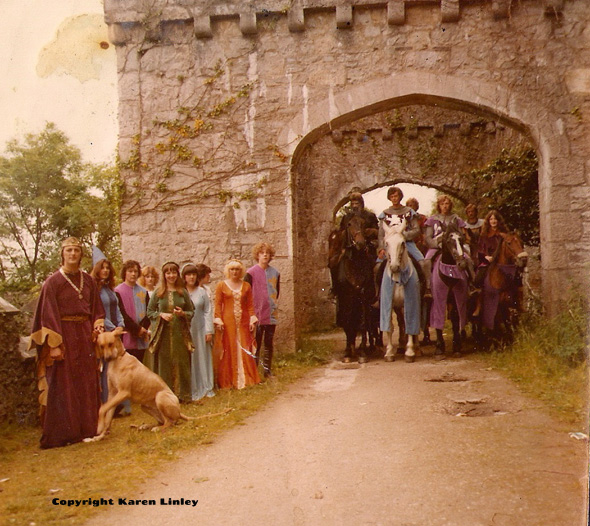
Karen Linley and the cast of Gwrych Castle Jousters and Banqueting team from late 1970s to early 1980s

Gwrych Castle – Jousters and Banqueting cast 1970/80s photo by Karen Linley

Here’s a gem of a photo from the personal collection of Karen Linley – aka The Lady of Gwrych. In the photo, she’s the one in blue dress between the women in green and orange. I love the movement of the dog in the pic. Thanks to Karen for permission to reproduce this here.

Karen Linley and the cast of Gwrych Castle Jousters and Banqueting team from late 1970s to early 1980s

Abergele’s 2012 Olympic torchbearers revealed

Here’s a list of the people who’ll be carrying the Olympic flame through Abergele on 29 May 2012

Eduard Kim (46) from Almaty

George Jacob (37) from Dubai

Gleb Nuriev (15) from Kondrovo

Graeme Johnson (69) from Dyserth

Joanne Wallace (34) from Warrington

Nathan Edwards-Hughes (19) from Abergele

Phil Jones(40) from Bodelwyddan

Stephen Bellis(56) from Mold

Steven Crossland(31) from Formby

(Source).

Good luck to all the Torchbearers, there’s sure to be a fantastic turn-out as the Torch enters town from the old road from Llanddulas, passes along Market St, turns left at the Gwindy lights down Water St, Dundonald Avenue and into Pensarn.

The Abergele Visitor

The Abergele Visitor was pushed  through our letterbox every Friday. It was printed in Abergele, in a room with lino on the floor above the Visitor Office newsagents, next door to the Bee.

Our neighbour Gordon Hughes was the printer and the noise of the rolling presses made it difficult to hear him speak as he explained how he set the lead type mirror-imaged for each week’s edition.

The paper’s chief photographer was Mr Sumners who had his office and darkroom between the Visitor Office and Woolworth’s. Mr Sumners seemed to be at every wedding, summer fete, sports day and chapel parade. He’d develop his own  photos and put prints of his latest shoots in his shop window, giving passing shoppers a good idea of what had been going on in Abergele that week.

Nowadays many local and regional papers are owned by bigger and bigger companies, based further and further away from their readers. But there’s something really cosy about remembering the days when  the stories of Abergele were told by the people of the town itself. People like Gordon Hughes and Mr Sumners.

Advert for Mr Sumner's Photography from an old map of Abergele.

This Little Piggy

Abergele is know as a market town because there used to be a livestock market here every Monday in the 1960s and 70s.

The town filled up with land rovers, tractors and trailers and farmers wearing flat tweed caps and holding shepherd’s crocks.

The market tradition is one that stretched back in time and there are old postcards that show that livestock trading used to take place on the main Market Street itself.

As you look today at Abergele Tesco, it’s hard to imagine that site was once full of corrugated iron sheds and animal pens, with the sounds and smells of prime Welsh livestock.

The sound of piglets squealing still sends a shiver down my spine. I’m back there now. I feel my hand being held tightly by my dad’s hand as he takes me there to see the pig sale.

“Gees, gees, gees!” he’d shoo some piglets out of our way. The smell’s overpowering. The auctioneer is pacing along planks placed between the pens, selling animals to the highest bidders.

The next time you buy a pack of shrink-wrapped pork at Tesco’s Abergele, remember that on this site, pigs once did squeal.

Abergele Livestock Market. Painted in 1969 by Harry Gee.

Magic Potions

When they were younger, our children loved making magic potions. They’d fill jam jars with water, mud, my wife’s perfume, Fairy Liquid, etc. Then they’d seal the lid and put them on display on their bookshelves for weeks.

Is there a genetic urge that makes us want to do this, I wonder? I ask because, when I was a child growing up in Abergele, I used to love making magic potions too.

Ann Morris and I would pick rose petals from the front gardens along High St and crush them between two rocks and mix them with water in a jam jar to make ‘perfume’.

In late summer, we crushed blackberries, elderberries and bilberries to make ink. And we even used the juice of raw onions to make invisible ink. It brought tears to our eyes. To reveal the writing we had to hold the paper close enough to a candle flame to heat the paper without burning it.

We’d make stinkbombs by throwing lighted matches into an empty Haliborange bottle, then close the lid quickly and wait until the flame went out.

Unscrew. Sniff, sniff. Phew!