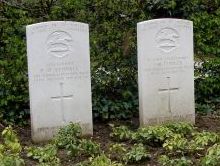
Rifleman R/5810 Arthur Jones, 2nd Battalion, King’s Royal Rifle Corps, 2nd Brigade, 1st Division. Killed in action, 12 January 1915, aged 33.
Arthur is commemorated on the Abergele War Memorial. He has no known grave and is commemorated on Panel 32 and 33, Le Touret Memorial, Pas de Calais, France.
He was the oldest son of the late Canon Thomas and Fanny Jones, of 14, Rhiw Bank Terrace, Colwyn Bay. Canon Thomas Jones had for many years prior to the war been rector of Abergele. Arthur was born in Ruabon, grew up in Abergele and enlisted in London. His youngest brother, Edgar Wilkinson Jones, was killed in 1917. His other brother, Frank Marsingale Jones was a Captain in the 9th Royal Welsh Fusiliers and was mentioned in dispatches June 1916. Frank died in Bedfordshire in 1957.
Arthur enlisted into the King’s Royal Rifle Corps in London on 13 October 1914. He was not new to the soldiers life, having served in South Africa (the Boer War) for over a year. For this he held the Queen’s South Africa Medal, with five clasps. At the time of his enlistment he was unmarried, 33 years old, 5′ 9″ tall with brown hair and worked as a Clerk. He gave his next of kin as his mother, Fanny, with an address, at that time, of ‘The Vicarage, Abergele‘.
He was at Winchester by 17 October 1914 and was posted to the 6th (Reserve) Battalion of the KRRC that was in training there. Given his experience in South Africa, his training was more of a refresher course and he was swiftly made available for overseas service. This came on 22 November 1914 when he was posted to the 2nd KRRC in France, disembarking there on 23 November 1914. 2nd KRRC had been part of the original BEF and had been involved in battle at Mons, Etreux, the Marne, the Aisne, Chivy and, most recently, the First Battle of Ypres. It was in desperate need of reinforcements.
Arthur was posted as ‘missing believed killed‘ 12 January 1915. His death on that date was accepted for official purposes on 28 March 1916, a move apparently prompted by a letter of enquiry written by Arthur’s mother on 1 March 1916. No further details as to what happened to Arthur on 12 January 1915 are available.
Second Lieutenant Frederick Harding Turner, ‘D’ Company, 1/10th (Liverpool Scottish) Battalion, King’s (Liverpool Regiment), 9th Brigade, 3rd Division. Killed in action, 10 January 1915. Known as ‘Tanky’, he was the Captain of the Scotland Rugby Union team.
Frederick is not commemorated in the Abergele district despite his connections with Llanddulas. He was buried in a cemetery but the precise site was subsequently lost in the fighting and he is commemorated on Special Memorial 13, Kemmel Churchyard, Heuvelland, West-Vlaanderen, Belgium. Other memorials include: War Memorial for the Royal Liverpool Golf Club, St. Hildeburghs Church, Hoylake; Garston Civic Memorial; Liverpool Cricket & Rugby Club War Memorial; SS Matthew & James’ Church War Memorial, Mossley Hill; Sefton Park Presbyterian Church War Memorial.
Frederick Harding Turner was born on 29 May 1888 in Liverpool, the younger son of William Neil and Jessie Turner. William was a principal partner in the Liverpool printing firm of Turner & Dunnett of Fenwick Street. He owned a second home, Bronwendon, in Llanddulas for a number of years until shortly before the war (today this is the building to the right of the entrance to Bron-y-Wendon holiday park on Wern Road). Consequently his two sons, Frederick and William, spent some time in Llanddulas when not away at school and they became quite well known in the area.
Frederick began his education at Greenbank school, Liverpool, where he began to learn to play Rugby, specialising as a flanker. From there he moved to Sedburgh School between 1902 and 1907. There he showed his athleticism in numerous sports and captained both the Rugby and Cricket teams. He also joined the Officer Training Cadets, was a prefect and won the Sixth Form prize. As he left for Oxford, his Master wrote of him, “I hardly remember such a combination of character, industry, and athletic distinction; when the three are in such a harmonious blend the type cannot be improved upon.”
In 1907 he moved to Trinity College, Oxford, to study law, gaining a third class degree in 1910. The quality of his degree may have been affected by his passion for sport, especially Rugby. In 1907 he had played for the Officers of the Army v the Officers of the Royal Navy in February and December. He played for Oxford University against the 1908-1909 Australian touring side, and also captained the University team to a welcome win against their arch rivals Cambridge in 1910 . He also played cricket for Oxford as a bowler, averaging a wicket every 16 balls and a batting average of 10 as well as for Lancashire County Cricket Club second XI. In addition he was a keen golfer. Whilst at Oxford, Frederick became good friends with a fellow Rugby player, Ronald William Poulton-Palmer. The two played together in the 1909 Varsity match, when Poulton-Palmer scored five tries.
The Oxford University Rugby team of 1909-10. Frederick is centre, with the ball. By Frederick’s side is Ronald Poulton-Palmer, Captain of England.
He left Oxford in 1910 with an endorsement from the President of the College, who wrote that, “Every undergraduate respected him, not only as an athlete, but as a thoroughly sensible and upright man, and all in authority knew him to be reliable in every way.”
He began working for his father’s printing company and played Rugby for Liverpool FC (Rugby Union) – known today as St. Helen’s Rugby Union Football Club. It was at this time that he probably took up temporary residence in Llanddulas. Known by now by his nickname of ‘Tanky’, due to his physical size and strength, he was called up for the Scotland international side, making his debut as a flanker in France on 2 January 1911. He became an ever present for that and the subsequent season playing against Wales, England, Ireland and France. His 5 conversions against France in 1912 was, at that time, a record equaling feat.
On 18 May 1912 Frederick was commissioned as a Second Lieutenant in the 1/10th (Scottish) territorial battalion of the King’s (Liverpool) Regiment. This battalion was very much known as a ‘Rugby’ battalion. One of Frederick’s comrades was Lieutenant Percy Dale Kendall who had been captain of the England international side in 1903.
The 1912-13 international rugby season also saw him bestowed with the honour of becoming Captain of the Scotland international team, leading his country to a famous 8-3 victory over England at Inverleith in the Five Nations / Calcutta Cup game and also playing against the touring South Africans. In 1913 he played in three of Scotland’s four internationals as Captain. He then announced his semi-retirement from international Rugby to concentrate on Liverpool FC, but answered the call in 1914 to play in what turned out to be Scotland’s final international before the outbreak of war, scoring a conversion in a 16-15 points defeat to England at Inverleith. The England team was captained by his old friend from Oxford, Ronald Poulton-Palmer. Frederick, Poulton-Palmer and six members of that Scotland team were destined to lose their lives in the impending conflict. In total, Frederick had gained 15 Scotland caps, scoring two tries.
Frederick as Captain of Scotland against South Africa in 1912
On the outbreak of war, Frederick volunteered for foreign service and was promoted to temporary Lieutenant on 25 September 1914. The 1/10th Liverpool (Scottish) battalion began arriving at Le Havre in November 1914, with Frederick disembarking on the 3rd. Whilst waiting for the battalion to be allotted to a Brigade, Frederick was involved in some ceremonial duties.
“Field Marshall Lord Roberts, who had been paying a visit to the Indian troops at the front, returned to Sir John French’s headquarters at St Omer suffering from a chill and died there of pneumonia on 14 November. On the 17th his body was to be taken to the Hotel de Ville for a short service and thence to the railway station to be removed to England for burial. The Liverpool Scottish had the honour of being detailed to line the Place Gambetta, in which the Hotel de Ville is, and also the street leading to it. One officer, Lieutenant F H Turner, and twenty picked men, were also detailed to take part in the procession, and a splendid looking lot they were, none of them under six feet in height.” ( A. M. McGilchrist, ‘The Liverpool Scottish, 1900-1919‘. N.B, according to his army records, Frederick was actually 5’ 11″ tall.)
Second Lieutenant Turner
The battalion was assigned to 9th Brigade, 3rd Division on 25 November 1914. They moved into the front line, near Kemmel, south-west of Ypres, on 27 November. Over the next few weeks they moved in and out of the waterlogged trenches. The winter was particularly harsh and the men must have been quite miserable. Many of the soldiers developed trench foot and other illnesses in the terrible conditions and by January of 1915 the battalion, which began with 829 men, numbered just 329, only 32 of whom had been killed in action. The battalion’s medical officer, Noel Chavasse , another friend of Frederick’s, was kept very busy. Noel had grown up in Liverpool, being the son of the Bishop, and was studying medicine at Oxford until 1909. He was also a keen Rugby player and, although not of the same standard as Frederick, it is easy to see how the two bonded. Noel Chavasse would go on to win two Victoria Crosses and the Military Cross and was the only man to be awarded two VC’s in the Great War, and one of only 3 to achieve that remarkable feat in history. He was badly wounded in 1917 whilst carrying out the feat that gained him the award of his second VC and he died of his injuries two days later.
It was during the harsh winter that Frederick saw his first opportunity to get more directly involved in the fighting frustratingly slip away.
“On 14 December, the 8th Brigade carried out an attack with two battalions, Gordon Highlanders and Royal Scots, on the enemy’s position in the Petit Bois. They jumped off from the trenches held by the Liverpool Scottish and Northumberland Fusiliers, whose men were withdrawn to Kemmel except for covering parties. The Scottish left in the line one platoon each of the “X” and “Z” Companies, under Lieuts. F.H. Turner and A.A. Gemmell, and the machine-gun section under Lieut. E McKinnell. Owing to a misunderstanding, part of “X” Company’s platoon left the trenches with the remainder of the company, and Lieut. Turner, thinking it hardly worth while to keep such a small covering party as the few men who were left, asked the Royal Scots for permission to join them in the attack but this request was refused.”
Frederick was clearly one of those young men with a desire to do more for the war effort and, despite the hardships and dangers, he was clearly enjoying it. It was during the dismal winter in the trenches that Frederick wrote to his brother stating;
“It is a man’s life out here, it agrees with me splendidly. I have never felt fitter in my life. True, we have had some hardships and not a little discomfort, but it has been a picnic in comparison with what the regulars went through. They are a magnificent lot.”
However, the opportunity to do more was not presenting itself. The 1/10th were in and out of the trenches carrying out routine tasks. Other than the occasional shelling and the ever present enemy snipers, the greatest threat to the men’s health was trench-foot. It was thus that, on 9 January 1915, the 1/10th battalion was in the trenches, still near Kemmel, for another routine day. During the night Frederick oversaw the laying of some new barbed wire entanglements in front of his men’s trenches. As dawn broke the following morning, a short distance away, having noticed some changes in front of the British position, a German sniper kept close watch.
After breakfast, Frederick made his way down the waterlogged trenches to inspect the work of the previous night.
“On the way he looked up twice for a second, and each time he was shot at, but both shots missed. He then got to a place where the parapet was rather low, and was talking to a Sergeant when a bullet went between their heads. Lieut. Turner said, ‘By Jove, that has deafened my right ear’. The Sergeant remarked, ‘And my left one too, Sir’. Lieut. Turner then went a shade lower down, and had a look at the wire, and was shot clean through the middle of the forehead, the bullet coming out at the back of his head, killing him instantly.” [Account from a fellow Officer, produced in De Ruvigny’s Roll of Honour 1914-24. I have identified the Sergeant as John Blake Jones. Sergeant Jones would later be killed by the same shell that would kill Fred’s brother, William Stewart Turner, in June 1915.]
Stretcher bearers and medical assistance were immediately called for. Quickly on the scene was Noel Chavasse but there was nothing he could do.
“We got him down to (name removed by censor) that night with great difficulty and buried him in the local churchyard in pouring rain. The grave, though baled out in the evening, was 18 inches deep in water. However it is quite the best cared for grave in the churchyard, and looks very pretty, with a nice cross put up by one of the other regiments in the brigade, and also a very nice wreath.” [Account from a fellow Officer, produced in De Ruvigny’s Roll of Honour 1914-24.]
It was Kemmel that the officer was referring to, and Frederick was buried in Kemmel churchyard. Unfortunately, this was later subject to heavy shelling and the exact grave site was lost. As his grave site is now unclear, a special memorial headstone has been erected.
His old friend Poulton-Palmer , Captain of the England Rugby team of 1914, and now of the 1/4th Battalion, Royal Berkshire Regiment, when he heard the news of his friend’s death, wrote that:
“I have played behind many packs of forwards, but never have I been so freed from anxiety as when those forwards were led by Fred Turner. His play, like his tackle, was hard and straight, and never have I seen him the slightest perturbed or excited and in this fact lay the secret of his great power of control….his face always showed his cheery satisfaction with the world at large. At any moment he would burst into that cheery and infectious laugh He was always ready to take his part in any harmless practical joking, on tour or elsewhere.”
” Fred was a gallant fellow, a universal favourite and the idol of the men under his command. His ever cheery manner and courageous bearing under all conditions endeared him to all his comrades. One of his fellow officers remarked to me that Fred Turner, above all men he had ever met, was one in whom it was impossible to find a fault, and I heartily endorse this opinion.”
Another officer wrote to his bereaved parents that:
“Others will tell you of his superlative qualities as a soldier. Never have I met a truer, straighter man than he, or one braver or more honest. He was a man all through – and he was such a dear good chap as a pal. We shall never forget him.” [Rugby Football Internationals: Roll of Honour]
That Frederick was loved by his platoon is clear from the fact that they would petition for his brother William to become their new Officer and also from the following account by one of his men;
“His first thought was always of his men; when their spirits were inclined to droop he rallied them and joked with them, though he always took upon himself the most dangerous and disagreeable duties. A sniper who had tracked him along the trench picked him off.”
The preacher of a memorial sermon, Rev. Alexander Connell, delivered in Sefton Park Church on the 19th January, 1915, emphasised his unusual modesty, and the fact that he had been a faithful attendant and communicant at that church; even after a heavy day on a Saturday he would take a long journey to be in his place in church on Sunday morning. He commented on;
“….Lieut. F. H. Turner’s deep character, which makes a man’s strength steadfast, protective, kindly. It was a life that shaped towards a settled usefulness and wise counsel in citizenship and the Church of Christ, a life on which many would have come to lean, a life that would have sheltered the weak, and been a staff to rest on by all who followed the chivalrous and righteous cause. His was a loyal soul – loyal to his home, his family, his club, his city, his country.”
Buried in the same cemetery as Frederick is his good friend Percy Dale Kendall, a former England Rugby Captain. His special memorial stands right next to Frederick’s: Scotland and England Captain’s, side by side.
***
[This account was originally written for publication elsewhere and I acknowledge the assistance of Joe Devereux, the expert on the King’s (Liverpool) Regiment, Pierre Vandervelden in Belgium, St. Helens RUFC, and colleagues from the Great War Forum, notably Gareth Morgan, Andy Pay and a chap called Robert who visited Kemmel for me and whose surname, I regret to say, I never quite got! All images are reproduced with permission from copyright holders or are out of copyright.]
Private 5718 David Davies (known locally as Dai), A Company, 1st Battalion, Royal Welsh Fusiliers, 22nd Brigade, 7th Division. Killed in action, 29 December 1914.
No known grave. Commemorated on Panel 5, Ploegsteert Memorial, Comines-Warneton, Hainaut, Belgium. Abergele War Memorial. Abergele Town War Memorial
David Davies was born in Abergele in September 1883, the son of Hugh and Annie Davies, of 1, Nelson Terrace (formerly of 3, Water Street). By 1901 he was working as a milkman and soon joined 2nd Volunteer Battalion of the Royal Welsh Fusiliers, a precursor to the Territorial Force. By 1905 he had moved to Conwy and a son, David, was born to him and his future wife in November 1905. He married Ethel Roseborough in Abergele on New Year’s Day 1906. At about this time he and Ethel moved to St. Asaph and three further children were born there: John Hugh in 1906, Phillip Henry in 1907, and Robert Evan in 1909. By February 1911 he was back in Abergele when a fifth child, Annie Matilda Mary, was born. Two further children were to follow, one of which was born in September 1914 (see below).
By August 1914, David was one month short of his 31st birthday, employed as a Labourer, and living with his wife and children at 34, Peel Street, Abergele. He was one of many local men to attend the first recruiting event to be held in Abergele, in the area in front of the town hall (where HSBC now is).
“Private David Davies was the first local man to respond to Lord Kitchener’s call for recruits. It will be recollected that at the recruiting meeting held in the Town Hall on Saturday, August 15th, Davies was the leader of about a dozen young men who mounted the platform at the close of a striking speech by Major Priddle.”
[Abergele & Pensarn Visitor, 2 January 1915. This story is also confirmed in the 3 September 1914 edition of the Welsh Coast Pioneer, however, David’s service record, which survives, records an attestation date of 24 August 1914.]
He travelled to Wrexham on 27 August 1914 for his army medical. He was recorded as being by 5′ 6″ tall, weighing 9 stone 4 pounds, with blue eyes and dark hair and with a scar above his right eye. The medical form also noted that he was a Wesleyan. He was declared to be fit and duly joined the 3rd Royal Welsh Fusiliers, the regiment’s training battalion for new recruits: and reinforcements for the 1st Battalion were soon to be desperately needed.
Following the annihilation of the 1st Royal Welsh Fusiliers at Zandvoorde on 30 October 1914 (see earlier posts on Isaac Jones and Allen Davies) , the remaining 80 or so men were combined with the remnants of 2nd Battalion of the Queen’s (Royal West Surrey) Regiment, one of their sister battalions in 22nd Brigade, until such time as reinforcements could bring the battalion back to fighting strength. A draft of 109 men and one officer joined on 5 November but the battalion was not fully withdrawn from action until 9 November when they marched to Bailleul to be joined by more officers and 99 more men. The following day the battalion marched to billets in Merris and over the next two days more officers and 454 more men joined.
The battalion was now back to near full strength and the reorganisation of companies and commands began. The battalion then spent time in and out the trenches just south of a line between Bois-Grenier and Fleurbaix near Armentieres before returning to full combat strength with the arrival of one last draft of an officer and 96 men on 23 November. David Davies was with this final draft and he went immediately into the trenches. Another small draft arrived on 11 December, bringing with it another Abergele man, Joseph Davies.
The Bois-Grenier sector was much quieter than had been the case around Ypres in October, but nevertheless David’s initial experience of war was hardly gentle. Trench ‘attrition’, the daily grind of casualties to shell and sniper fire, was the routine in this sector, and in David’s first week 6 men were wounded, 1 was missing, 1 was killed and 2 more died of wounds. Despite brief periods in billets in reserve the battalion stayed in this sector throughout December, and hardly a day went by without one or two woundings and the occasional fatality.
In a letter home, written days before his death, David Davies had written, “Just a line. You know that I am quite well and have been in the trenches six days and nights. It was very wet, and we were up to our necks in clay, but we came out alright. I am still in the same spirit – as happy as a schoolboy, and as cheerful as the birds in May…I hope you are not fretting about me, as I am in grand health and in good condition. When I come home you will be surprised to see me drinking coffee, and that without sugar. You complain about foodstuffs being dear in Abergele. Sugar here is 1/8 a pound. We are getting plenty of tobacco and cigarettes in the trenches and out. So we are quite happy and comfortable.”
David would probably have written this letter on Christmas Day 1914, in billets at Rue de Bataille, as the battalion had been relieved from the trenches on Christmas Eve by the 1/8th Royal Scots. However, the rest period was short and on the night of 28 December the 1st Royal Welsh Fusiliers relieved the 1/8th Royal Scots and went back into the line.
Nothing specific happened on the next day, the day that David died. The battalion was in the line and he became another victim of ‘trench attrition’. The battalion’s war diary records nothing more than the arrival of a new officer, a few reinforcements and “casualties other ranks, killed 2, wounded 3” .
On 2 January 1915, as yet still unaware of his death, David’s wife, Ethel, and parents proudly shared their recent communications with the Abergele & Pensarn Visitor. In a letter to his parents he had commented, “It is very wet out here and the trenches are very muddy. But things are not as bad as the papers at home make them.”
Within a few days Ethel Davies received a devastating letter from David’s Platoon Commander, 2nd Lieutenant Trevor Reece, dated 30 December. He wrote, “I regret to have to inform you that your husband was killed at 3.30 yesterday afternoon whilst doing his duty as sentry. He was shot through the head. His death is a great loss to the company, as he always did his duty well and cheerfully. Please accept my deepest sympathy in your bereavement.”
On 9 January the Abergele & Pensarn Visitor commented, “The sad news caused widespread sorrow in the district and a large number of influential residents called to sympathise with his widow and the seven little orphans. An Abergele soldier who was within a few yards of Davies when he was shot wrote that he met his death by a shot from an aeroplane.”
The newspaper went on to print a poetic eulogy penned by Ben Cybi Williams, ending with the words, “And what of his children? Oh, God do thou grant that the seven shall not suffer, that the wife shall not want”.
As a single casualty in his own trench lines, David Davies would have been buried by his comrades. Unfortunately, in an area that was fought over repeatedly for almost the duration of the war, the grave was subsequently lost and today he is one of 11,360 names inscribed on the Ploegsteert Memorial to the missing.
The news of David’s death hit his older brother Hugh particularly hard. Hugh had always wanted to be a soldier. He had been a member of the 2nd Volunteer Battalion Royal Welsh Fusiliers at the time of the Boer War but was turned down three times to go to South Africa due to a defect with his left eye. He tried to join the regular army again in 1903 but was once more refused. Immediately upon the news of his brother’s death he vowed to try again, and before the end of January 1915 he had volunteered and been accepted to join the Royal Engineers.
A year after David’s death his sister Mary placed an ‘In Memoriam’ in the local newspaper: “Far and oft my thoughts do wander to a grave so far away, where they laid my loving brother just a year ago today”.
David’s youngest son was born in September 1914. It is unlikely that he saw him more than once or twice – immediately after the birth or during a final leave before embarking in November 1914. In the patriotic spirit of the day his son was named William Kitchener Davies. William would follow in his father’s footsteps and one day enlist into the Royal Welsh Fusiliers. He was killed in Normandy, in the fight for Caen following D-Day on 21 July 1944, and is buried in Brouay Cemetery. Unlike his father, he is not commemorated on the Abergele War Memorial.
Private 12233 Frederick Edwards, 2nd Battalion, Royal Welsh Fusiliers. Died of natural causes, 14 December 1914.
Known simply as Fred, he was born in St. Asaph, enlisted in Rhyl and lived in St. George. He arrived in France at Le Havre on 24 November 1914 as a reinforcement for the 2nd Royal Welsh Fusiliers. He was hospitalised at Le Havre almost immediately and before he could be sent to join up with his new battalion at the front he died on 14 December 1914.
Plot Div. 14. H. 1., Ste. Marie Cemetery, Le Havre, France. He is commemorated on the St. George War Memorial.
Private 8252 John Thomas Jones, 2nd Battalion, Royal Welsh Fusiliers, 19th Brigade, 6th Division. Died of wounds 31 October 1914.
Known as Thomas. A former professional soldier and army reservist called up on the outbreak of war and in France from 13 August 1914. Son of John Lloyd Jones. Born and enlisted in Abergele. Lived with his parents at 3, Mount Pleasant, Abergele, before getting married. Once married he lived in Penmachno, near Betws y Coed. He had three children. He is not recorded on the Penmachno War Memorial. Brother of Isaac Jones, who was killed the day before whilst serving with the 1st Battalion (see below). Plot C. 13, Bailleul Communal Cemetery, Nord, France. He shares a grave and headstone with Private J. Postlewaite of the 2nd Durham Light Infantry who was killed on the same day. Abergele War Memorial. Abergele Town Memorial.
John was seriously wounded in the head on 30 October and placed on a stretcher by a haystack, where he was seen by Private Bob (Robert) John Williams of Pwll Coch, who had, by chance, crawled for cover to the same haystack having been badly wounded in the back by shrapnel.
John’s father was informed of his son’s severe wounding in late November 1914. A week later came news that his son had died of severe wounds to the head. It was about the same time that news of Isaac going missing in action was also received.
Private 11126 Isaac Jones, 1st Battalion, Royal Welsh Fusiliers, 22nd Brigade, 7th Division. Killed in action 30 October 1914, First Battle of Ypres, aged 24.
[See Allen Davies (below) for details of events surrounding the annihilation of the 1st Royal Welsh Fusiliers on 30 October 1914. Amongst the casualties of that day were two Abergele men, Isaac Jones and Allen Davies.]
A professional soldier. Son of John Lloyd Jones. Lived 3, Mount Pleasant, Abergele, along with his family. Born Abergele, enlisted Wrexham. Brother of John Thomas Jones who was severely wounded in the head on the same day that Isaac was killed, and who died the following day whilst serving with the 2nd Battalion (see future entry). In 1911 Isaac was still living at home with his widowed father and his older brothers, David Lloyd and Evan. Evan was later exempted from conscription. At that time, Isaac was employed as a Farm Labourer. He therefore joined the army at some point between April 1911 and August 1914. No known grave, Panel 22, Ypres (Menin Gate) Memorial, Ieper, West-Vlaanderen, Belgium. Abergele War Memorial. Abergele Town Memorial.
Isaac’s father received mixed messages as to the fate of his son for quite some time afterwards. In early January 1915 the family were informed that Isaac had been severely wounded on the one hand, and missing on the other hand. Officially he was posted as missing and this was still the case in July 1915. It was much later that assumption of his death on 30 October 1914 was received. Unlike Allen Davies, his body was either not recovered or not identified.
[ A memorial to the men, like Allen Davies and Isaac Jones, of the 1st Royal Welsh Fusiliers who died ay First Ypres has recently been unveiled: click here ]
Private 10936 Allen Davies, 1st Battalion, Royal Welsh Fusiliers, 22nd Brigade, 7th Division. Killed in Action 30 October 1914, First Battle of Ypres, aged 22.
Son of John and Alice Davies, of 1, Fron Hyfryd, Groes Lwyd, Abergele. Born Birkenhead, enlisted Wrexham, lived Ty Gobaith, Old Colwyn. A professional Soldier. In 1911 he had been a Labourer at Tyn y Caeau Farm, Betws yn Rhos. Brother of John Davies, 2nd Cheshire, who would die of wounds, 2 May 1915. Plot IXA. L. 10., Hooge Crater Cemetery, Hooge, Ieper, West-Vlaanderen, Belgium. Abergele War Memorial. Abergele Town War Memorial. Rhyl War Memorial.
The 1st Royal Welsh Fusiliers, 22nd Brigade, 7th Division, arrived in Zeebrugge, Belgium, on 7 October 1914 on board the troopship Winifredian. Within two weeks the battalion would all but cease to exist, and over 900 of the nearly 1,000 men on the Winifredian would be dead, wounded or missing.
They were to assist in the defence of Antwerp but the war of movement in this early part of the war was quite fluid and for the next week 7th Division was constantly marching to new positions in support of French and Belgian troops. On 14 October they arrived at the Belgian town of Ypres and were ordered into the line at Zonnebeke before moving forwards to Dadizele on 19 October and engaging the Germans for the first time in what is known as the First Battle of Ypres. The next days would be awful.
Between 19 and 21 October the battalion lost 87 men dead with many more wounded and missing. The battalion was withdrawn from action into a reserve role and a roll call on the 22nd counted just 6 officers and 206 men, with as many as 213 men listed as missing. Despite the reserve role, pressure from the Germans was still intense and another 15 casualties were recorded up to 24 October when the depleted battalion found itself at Veldhoek, north of Ypres. It was here that, in a rare moment of humour, the battalion adjutant recorded in the war diary that, in addition to the regimental goat, three further goats had attached themselves to the battalion and refused to leave. On the 26th a party of 90 reinforcements joined and the battalion, desperate for rest, moved a few miles south to Zillebeke on the 27th, suffering a further 20 casualties.
On 29 October 7th Division found itself under another strong German assault. 22nd Brigade and 1st Royal Welsh Fusiliers were in reserve and avoided the worst of the attack, but once again they had to move and dig-in in a new location as the Division was pushed back 500 yards.
“This meant that the work of the previous days had to be begun all over again….the strain was telling heavily now on officers and men. They had been fighting almost continuously for ten days: they had been far from fresh when they started fighting; they were now shorter of sleep than ever, few had had the chance of a wash or a shave, meals had been scanty and irregular….” . [‘The 7th Division 1914-1918’, C. T. Atkinson, 1926, p.79.]
A new divisional line was established, with its right held by the 1st Royal Welsh Fusiliers slightly east of Zandvoorde, a village on a slight rise held by the Household Cavalry. As dawn broke on 30 October the Germans;
“…were at it again, shelling the whole line with renewed fury and devoting special attention to Zandvoorde and the ridge upon which it stands. This was held by the Household Cavalry, and it was on them that the brunt of the bombardment fell….the Household Cavalry hung on valiantly , but their trenches were practically obliterated by the bombardment, and when at length the German infantry pressed forward to the assault there were but few defenders left to meet it. The ridge and village appear to have passed into German hands rather after 8 a.m., and almost immediately the Welch Fusiliers, already well employed in keeping off the German infantry in their front, found themselves enfiladed from the right. They still held on stubbornly, but the Germans brought a battery right forward which came into action on the Zandvoorde ridge itself and did terrible execution among the Fusiliers, whose trenches had already been badly mauled by the storm of shells which descended upon them.” [‘The 7th Division 1914-1918’, C. T. Atkinson, 1926, p.81-82.]
The events of the day as they affected 1st Royal Welsh Fusiliers directly are very unclear. The war diary is torn with a chunk missing and all that can be read is, “The enemy attacked the trenches of….the battalion at daybreak, and….cavalry on the right giving way…” [War Diary, 1st Royal Welsh Fusiliers, WO 95/1665] The Adjutant, Captain Dooner, had kept a very detailed diary until this point and was obviously writing these words in a shell-blasted trench as the disaster was unfolding about him. What we do know is that the battalion, already a shadow of its original self, was effectively surrounded and decimated. The war diary, now written in a different hand some time later, picked up the story:
“The exact nature of the casualties that day are unknown, but the following officers [12 are listed] and 320 NCO’s and men were found to be missing that day. No accurate information is available regarding this action…” . [War Diary, 1st Royal Welsh Fusiliers, WO 95/1665]
The fighting around Zandvoorde was brutal and continued for many hours more but;
“….before this, however, the Welch Fusiliers gallant resistance had come to an end. They had fought stubbornly on, the hopelessness of their position notwithstanding, and had thereby greatly delayed the German advance. But, taken in flank and rear, enfiladed and hard pressed in front, their destruction was only a question of time. Of the 12 officers and rather over 400 men to which the battalion had been brought up, only 86 men were present at the end of the day. Colonel Cadogan, his Adjutant, Captain Dooner , and the great majority of the officers and men were killed, only four officers and about fifty men being reported later on as prisoners, and most of them wounded.” [‘The 7th Division 1914-1918’, C. T. Atkinson, 1926, p.84.]
Amongst the casualties were two Abergele men, Allen Davies and Isaac Jones (see above). Allen’s death was not confirmed for some time and, when news came through to his parents that their other son, John Davies of the 2nd Cheshires, had died in May 1915, Allen was still officially listed as missing in action. The precise details of Allen’s death may never be discovered and even the date is suspect: as his medal index card records, the date was merely ‘accepted’ at a later stage.
His body was recovered after the war and identified by means of his identification disc. He was exhumed and reburied at Hooge Crater Cemetery on 21 May 1919. Also exhumed at his location, and now buried adjacent to him in Hooge, were the aforementioned Lieutenant Colonel Cadogan and Captain Dooner.
Private 7017 John Roberts, Somerset Light Infantry, 1st Battalion, ‘A’ Company, 11th Brigade, 4th Division. Killed in Action 21 October 1914, Attack on La Gheer, Battle of Armentières, First Battle of Ypres.
Listed as ‘John Roberts, Towyn’ on the Abergele War Memorial. Born Conwy, enlisted Swansea, lived Manchester Cottages, Towyn. No known grave, Panel 3, Ploegsteert Memorial, Berks Cemetery Extension, Comines-Warneton, Hainaut, Belgium. Abergele War Memorial. Abergele Town Memorial. Towyn War Memorial.
John arrived in France 11 September 1914 as a reinforcement for the 1st Somerset Light Infantry which had landed 22 August 1914. The 1st Somerset Light Infantry moved from Armentieres to Ploegsteert on 20 October 1914. The following morning they marched to the north-east corner of Ploegsteert Wood and took part in an attack on La Gheer.
La Gheer was a hamlet in the British 12th Brigade area, astride an important crossroads at the south-east tip of Ploegsteert wood. At 5.15 a.m., 21 October 1914 a strong attack on the British 12th Brigade by eight battalions of the German XIX (Saxon) Corps was launched. The 2nd Royal Inniskilling Fusiliers, holding La Gheer, were forced backwards losing many men as prisoners of war in the process.
Its posession by the Germans threatened British control of the entire wood and allowed them to enfilade British positions both north and south. It was vital that La Gheer was retaken quickly and the task was assigned to a mixed force of four battalions from 12th and 11th Brigades, including the 1st Somerset Light Infantry. The attack involved John’s A Company, supported by B Company, advancing from the eastern edge of the wood and turning southwards. The assault required a bayonet charge on German positions in the hamlet of La Gheer. The hamlet was soon cleared and taken.
The attack had been a great success and captured 143 German prisoners as well as releasing 45 Inniskilling Fusiliers who had been captured in the initial German advance. The cost of the success was 1 Officer and 7 men killed, including Private John Roberts of Towyn.
John’s body was either not recovered, not identified or buried in a grave that was subsequently lost, and his name is commemorated on the Ploegsteert Memorial.
Unlike all the other commemorations that I will post, this one is actually requesting help, and any that can be given would be gratefully received as Fred has eluded me for many years.
He is recorded on the Abergele War Memorial and on the Town Memorial. He is listed on the ‘Roll of Honour of Abergele Officers and Men’ as printed in the Abergele and Pensarn Visitor, 30 January 1915, as having been killed, so he had died before that date. Another source suggests that he lived at Morfa Cottage on the border between Towyn and Bodelwyddan. Adding significantly to the confusion is the article below from the Liverpool Daily Post of 23 December 1914.
The only Fred Williams of Abergele to die in the war was from Bryntirion Terrace and he died in Gallipoli in August 1915. Therefore the article below must be referring to Fred Roberts of Morfa, despite getting his surname wrong. However, no Fred Roberts of the Royal Field Artillery died in 1914!
What the article does do is narrow the time period for Fred’s death to before 23 December 1914, but even this does not really help. There were three men named Fred Roberts who died in 1914, but two were killed in action, not by typhoid, and the other died in the UK.
Private 429 Leo Dobbins, 1/1st Denbighshire Yeomanry. Died 30 September 1914, aged 19.
Son of John and Bridget Dobbins, of 138, Wellington Street, Rhyl. Born Rhyl. Enlisted Rhyl. Plot 100, Rhyl Town Cemetery. Rhyl War Memorial. Prestatyn War Memorial. Not commemorated in the Abergele district.
Leo was a pre-war member of the Denbighshire Yeomanry and was mobilised immediately on the outbreak of war in August 1914. In civilian life he worked as a Clerk at Abergele Post Office and was well known and liked in the district even though he was not from Abergele itself. He died of natural causes in the military training camp at Bungay, Norfolk, where the Denbighshire Yeomanry were training at the time.