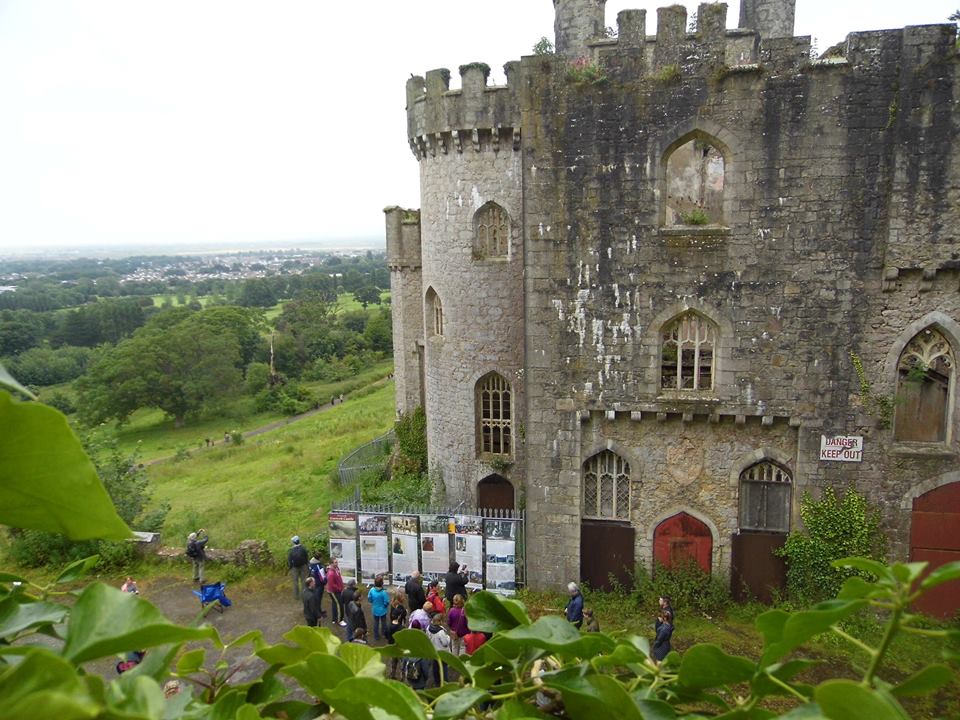
Gwrych Castle Open Day

Last Saturday the Gwrych Castle Trust opened the gates of the castle to the public for the first time in thirty years. Here are a few pictures of what was an extremely successful day. Thank you to the Gwrych Castle Trust and the current owners of Gwrych Castle. These pictures belong to Jackie (Skippy) Rowlands and she has given her permission to reproduce them here. Thank you Jackie.

10407871_911740585519695_4592627693573745456_n 10409371_10204211410989339_4278193033757119827_n 10420246_911741775519576_4676555000870057862_n 10450654_10204211557753008_2951326204476797892_n 10450813_10204211499271546_7041636070774448870_n

Shire horses at Abergele National Ploughing Championship

In the past, the Women’s Institute has produced sets of coloured postcards celebrating all kinds of events and landmarks around Abergele. Here’s a photo by Gwyneth Vaughan of Betws yn Rhos WI, showing the Abergele National Ploughing Championship. Although this plough is pulled by horses, judging by the estate car in the background, this is a fairly recent competition.

Abergele National Ploughing Championship. Photo by Gwyneth Vaughan of Betws yn Rhos Women's Institute
Abergele National Ploughing Championship. Photo by Gwyneth Vaughan of Betws yn Rhos Women’s Institute

Chapel Street’s Mount Cottages

Local historian and AbergelePost stalwart Andy (Nigel) Hilton has responded to the discussion about Mount Cottages over on this page.

He says: “I’ve managed to cobble together the relevant sections of two halves of the 1872 OS Map covering the Chapel Street/High Street area. They may shed some light on Andrew Hesketh’s comments regarding the 2 other Mount Cottage properties in the vicinity of the Old Police Station. I’ve also found an aerial photo which shows that same area, probably in the 1930’s I’d guess.”

Chapel St.1872 aerial view of Abergele


Novella about growing up in Abergele free to download for Kindle for a few days

I’ve written here before about Abergele author Rob Burslem.  He’s perhaps best known for his books set in Africa (Murdoch’s Africa). I’ve just heard that his Abergele novella Three Pomegranates and a Half Bottle of Scotch has been made available for free download by Amazon for a few days as a Kindle edition.

If you’re reading this article after about mid May 2014, you’re probably too late to get it for free, but the novella’s been well reviewed on the store, so it’s worth a look.  Reviewer Paul writes: “This was an excellent read. I couldn’t help but have empathy with Kevin’s plight. The conversational style felt really authentic. As the story progressed I couldn’t put the book down. I actually chocked when I read the author’s note at the end.


St Davids Day – let’s party like it’s 1909

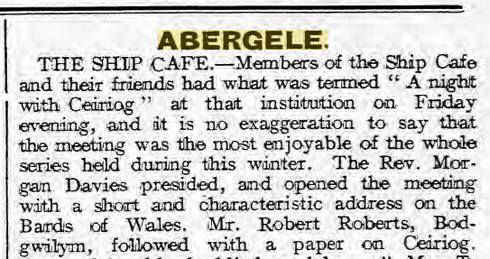
I’m a fan of the National Library of Wales’s Welsh Newspapers Online site. Here’s a clipping from the Weekly News, 5 March 1909, describing St David’s Day celebrations at the Bee Hotel, Abergele, in that year.

copyright National Library of Wales reprinted under their open license
Copyright National Library of Wales. Reprinted under their open license

ABERGELE. St. David’s Day was celebrated in Abergele with a dinner at the Bee Hotel, and a coffee supper, followed by a concert, at the spacious Wesleyan schoolroom, the latter being held by members of the Ship Cafe.

Both events went off splendidly. The meeting at the Wesleyan schoolroom was presided over by Mr. J. R. Ellis, I when the programme was sustained by Mr. G. T. Morgan, Mir. T. Derbyshire Roberts, Misses Harrison, Miss Katie Jones, M’aster Harold Cybi Williams, Miss Lizzie Davies, Master John Millward, and Mr. Ben Cybi Williams.

The only toast submitted to the meeting was “Dewi Sant,” proposed by Mr. J. R. Ellis, and elaborated upon by the Rev. Morgan’ Davies., who was in grand form. He declared that St. David. ‘kindled such a fire of patriotism in Wales that time can never extinguish. (Applause!.)

On the motion of Mr. J. Williams, M.A., seconded by Mr. Edward Ellis, the thanks of the meeting was accorded ‘o all those who had contributed towards the success of the gathering. Mr. R. E. Needham enlivened the proceedings with several, gramaphone selections.

AT THE BEE HOTEL. St. David’s Day has been. celebrated at the Bee Hotel for many years. As usual, there was a large and distinguished company present at this year’s function. The catering of Mr. and Mrs. Featherstone was Ai. ‘Mr. G. H. Judson bad the honour of being president, whilst Mr. S. B. Rogers occupied the vice-chair. Amongst others present we’re Messrs’. E. A. Crabbe. T. Hannah, J.P., J. Gill, E. W. Brtdley, Kinmel; J. Calvert, W. Jones, Chapel Street; W. Chesters, D. W. Vau.gh.an., J. Williams, Harp Hotel; D. Williams, Kinmel Arms; Humphrey Williams, Valentine Hotel, Llanddulas; W. J. Parry, London House; J. Pierce, Victoria House; Richard Jones, Pentre Ucha’ E. Wo’n’a.ll, Cambrian Hotel; G. Perkins, Elias Evans, Pensarn; E. W. Harrop, J. Edwa.rd=, T’anyfron; D. Wil- liama, Ty lgwyn,; W. BTiothetrtoQ, E. W. Parry, Rihyl; and F. Hajdon, Rhyl. The toast list was as foHow.s:—”The King,” by the President; The Queen, the Prince and PfTMicesa of Wales, and the Rest of the Royal Family,” by the Ptresident; The Navy, Army, and Territorial Forces,” proposed by Mr. CraLbe, and responded to by Mr. J. Gill; To the Im- mortal Memory of St. David,” proposed by M’r. S. B. Rogers; The Town and Trade of Abergele,” proposed by Mr. J. Edwards, Tanyfron; The Farming Industry,” proposed by Mr. J. Pierce, and responded to by Mr. D. Williams, Ty Gwyn; “The Host and Hostess,” proposed by Mr. G. Perkins, Mr. Featherstone responding.

Songs were sung by Mir. Bradley, Messrs. Johnson and Foye, Manchester, Mr. Hanlo.n, Rhyl, and Mr. D. W. V.au;ghan. Mir. Crabbe said the British Navy waa every .ready to, respond tOl the call of duty. The Army,, though at the present moment in a transient stae, was ready for every emergency if necessity arose. Aided by the Daily Mail,” the Terri- torital Force in London had attained its required strength, and he sincerely trusted that the other parts of the country would follow the example set before, them by the capital of the Empire. If the Territorial Force failed, then there would only be one, alternative—namely, conscription, and that would mean a national calamity.

In responding, Mr. Gill said the Territorial scheme was the last effort—the last kic’k—to avoid that deplorable system of conscription. .Even now, the Territorial Force was three times the value of the old Volunteers. Mr. ludson. in resDondin? to’ the toast of his health, said that since he had been a member of the Council he had done his best for all con- canned.

Something had been said about his fo.rthcorning marriage. (Applause.) Well, he might as well let the, secret out by saying that he was to. be married on the grd of June. (Loud .applause.)’ Mr. Perkins, in pro.po.sing the health of the host and hostess, said everyone present would feel sorry at My. Featherstone’s departure from Abergele. ..Mr. Fea.the.rs.tone, in responding, said he was sorry to, leave Abergels, but he was saddled with a house at Colwyn, Bay. The meeting broke up with the singing of Auld Lang Syne and God Save the King.” SEARCHLIGHT.

———————————-

Back to today now: as you can see, the optical character recognition isn’t perfect, but it’s quite good. So you’ll notice the typos above.

Interesting to note the military discussions which foreshadowed the beginning of WWI.


The Old Pubs, Inns and Taverns of Abergele in the 1800’s

In replying to a query posed by Gareth regarding the Sun Inn (see Market Street topic), he suggested that I start a new post on the subject of the old pubs in the town, so here goes.

We are fortunate in that Charles Jones (1843-1916) kept detailed diaries between 1861-1914 which has allowed us to follow those changes which took place in the town during that period. Ellis Wynne Williams (EWW) in his book ‘Abergele, the Story of a Parish’ makes use of those diaries and other sources, so it is thanks to them that we have the following information:

EWW makes reference to the Rate Book of 1859 which lists 14 taverns etc., whilst an 1862 Plan of Abergele (see below) shows 16 Hotels & Inns. Those in the Rate Book (annual rental shown in brackets) were The Gwindy (£15), Ship (£16), Mona Vaults (£12), Bull (£20), George & Dragon (£7), Royal Oak (£16), Cross Keys (£16), Harp (£18), Swan (£14), Kings Head (£10), Crown (£18), Nelson (£34), Castle (£18) and lastly, The Bee (£184). The last two are the Penybont and the Bodelwyddan Arms (Hesketh) which I will deal with first.

Abergele Town Plan 1862

The Penybont was originally the name of the house which adjoined a low, narrow tavern which ran alongside the river Gele and to which it was later joined to form the present-day building. Similarly, the Bodelwyddan Arms, as it was known in 1861, was also joined to the next-door house, forming the Hesketh of later years. The Castle was the last of only three pubs in the town to be joined to the house next door in the 1860-1900 period. The Castle, then as now, is situated at the northern end of the junction between Pleasant Place and Dundonald Avenue. Around that time there was a clamour to close or pull down the small taverns. The Compensation Act, which had recently been passed at that time, might have been all the incentive required in some cases. But I digress.

From the 1860’s onwards Abergele saw much change, which included the disappearance of many of its taverns. Of the few left from the 1859/1862 period, only the Gwindy, the Bull (Hotel), a larger and much improved George & Dragon, the Harp (whose frontage didn’t alter at all between 1861 & 1911), Castle, Bee and Penybont survived. The Hesketh is still there on Bridge Street, almost opposite St. George Road, but under a new guise. Although the name ‘the Ship’ survives to modern days, it is not the same Ship Inn as mentioned in the listings however (see below). The Bee Hotel, two doors up from Church Street’s junction with Market Street, still occupies its original site. But what of the others?

That part of the modern day Peter Large’s property closest to the Harp is where the Cross Keys once stood. Described as ‘quite a good house with its two front rooms, one a shop, the other a tavern’ it was run by one Huw Jones in 1861, a joiner and zealous Baptist according to the diaries. Directly across the road, where Reeds Rains is nowadays, was The Swan. The original building was demolished to be replaced by a chemist’s shop in later years. The Crown is where Gwalia House, a modern day butcher’s shop, now stands. It was a butcher’s shop even in the late 1800’s, as well as a tavern, kept by a prominent Wesleyan, Edward Roberts. Behind the Swan and the Crown stood the Kings Head. The Royal Oak occupied one of the five small ‘two-up, two-down’ houses between Liverpool House (the bridal shop) and the Harp, probably where the barber’s shop is today. Interestingly, in 1891, the Post Office (formerly at Bowden House in Chapel Street) moved to one of those houses where it remained until moving to the present location in 1909. The George & Dragon was known as the Royal George in the early 1860’s. Originally described as ‘a low, old thatched house with no loft to it’ one can perhaps understand why the annual rent only increased from £7 in 1859 to £18 by 1890. For comparison The Harp, Crown & Castle were all rented at £18 p.a. in 1859, others somewhat more.

Charles Jones’ diaries take us on a clockwise tour of the town so we will pick up his descriptions in Water Street. Where the present day Tannery Court now is a cluster of half a dozen properties once stood, one of which was the White Horse tavern. For some reason, Ellis Wynne Williams’ book doesn’t show this on the 1862 Plan, nor does he mention it being in the 1859 Rate Book. He does, however, mention Nelson Vaults, part of Nelson House where Prys Jones & Booth carry on their business today. Jones’ diaries describes it as ‘quite a large property where much business was transacted’.

Across the road from Nelson House were three shops and the ruins (in 1861) of the old Lock Up. ‘In this block was the first North & South Wales Bank, the building next to it in the main street being for many years a tavern by the name of Bank Vaults’. This is another tavern which doesn’t make it into the lists in EWW’s book. ‘Next was the Red Lion, an important tavern which did much business’, sited where the current opticians is. The Penybont and Hesketh have already been discussed above so, bypassing them, our tour continues further along Bridge Street. Where Plas Newydd Buildings twin terraces now stand ‘there were many old thatched houses. Beyond them was an old long and low thatched house facing the road called New Inn. It had been a tavern long before 1861’ and is yet another not shown in the listings. It was situated roughly where Slaters have their Service building next to Ysgol Emrys ap Iwan these days.

We now about-face and head back towards the bridge over the river Gele which, ‘in 1861 was a stone arch, considerably higher and narrower than it is now’ an improvement which occurred around 1906. The first building on the corner of Glanrafon and Market Street (the Mobility shop) was a butchers for many years prior to becoming the Crown Bach (not to be confused with the Crown/Gwalia House at the other end of town). Proceeding onwards we arrive at ‘the Gwindy which remained unaltered between 1861 and 1911 and did a great trade’. Next came Cumberland house with a watchmaker’s shop, Glyn Luce, being built in the later part of the 1800’s on the site of the former tavern by the name of Mona Vaults.

Though off topic, it is interesting to list the remaining properties from Glyn Luce/the Mona Vaults if only to show their diversity. ‘Then came Bryn House and then a private house with a milliner’s shop built about 1862 next to it. Also about 1861 a Watchmaker’s shop called Grenwich house was built next to the milliner’s. Then came a farm called Ty Newydd, … next was a shop in which Edwards y Caws sold cheese’. I have mentioned those because the next property was ‘the Ship Inn, a free house with two quite sizeable rooms at the front’. This should NOT be confused with the later Ship Temperance Cafe on the corner of Market Street/Chapel Street, which didn’t open until 1907. But, to continue our description – ‘between the Ship Inn and the corner of the Llanfair Road were two shops, a milliner’s and a grocer’s. Shortly before 1861, the grocer’s shop was a tavern called the Bull and when the present Bull Hotel was built, about 1860, it became known as the Bull Bach (Little Bull) because only one of its rooms was used as a tavern at the beginning, the other being used as a shop’. What later became the Ship Temperance Cafe, a Youth Club in my time and currently a Herbal Medicine Practice, was built partly on the site of the old Bull (Bach) Inn. The story behind the origins of the Ship Temperance Cafe is interesting in its own right but not for this page.

Our perambulation of Abergele’s old taverns is almost complete with the exception of the northern side of Market Street. In 1861, the space where the Town Hall was later built in 1867 was just an open space. To the rear of this space the Market Vaults were built and served as a tavern between 1867 and 1910. The houses (demolished in 1966) in Market Place were also built about 1867 and called Local Lane. By walking westwards along Market Street, we eventually arrive at the former sites of the Crown, King’s Head and Swan to complete our circuit.

For the purists, Pensarn underwent much development in the 1850’s following the arrival of the railway in 1845, then remained largely unchanged from 1861-1911 apart from the disappearance of the White Horse Inn and the Glyn Vaults (their old locations unknown). This only left two remaining public houses to survive to the present day, The Railway (currently The Yacht) and the Cambrian (now The Park) both on the seaward side of the A548/Marine Road.

The railway appears to have been the catalyst which brought about much of the change mentioned above. Gone were most of the old taverns, which had probably been little more than a couple of planks laid across trestles in someone’s front room and with a barrel or two of ale upon them anyway. A far cry from today’s public houses with their modern image, plying their trade in buildings which have survived for over a century and a half in some instances.

Mount Cottages

The Mount

Gareth, on 23 March last year you passed on an appeal for information from Juliet Roberts, regarding the location of Mount Cottages. Delyth MacRae & Brian Haynes were able to provide the answers. Subsequently I’ve found this copy of an 1872 map which may assist further. I’d always thought the cottages were those shown just above the No.744 in the image, immediately to the south of the Mount itself. Perhaps Delyth of Brian could clarify?

Mount Cottages

New novella about a boy growing up in Abergele

Abergele author Rob Burslem has published new e-book called “Three Pomegranetes and a half bottle of Scotch

Rob wrote to Abergele Post to let us know about the book because it’s about Abergele. The blurb on the book cover says:

“It is a story inspired by true life events. It depicts with compassion the poverty that existed in North Wales during the 1950’s and 60’s.  Kevin is faced with an imminent and cataclysmic life changing event. He has to decide if it’s worth going on. Before he makes that decision he needs to face up to his past and the bad things he has done to the ones he loves. He has to decide if redemption is possible. All the basic events are true and characters real.”

Rob adds that – for a limited time – readers can download a free Kindle copy from Amazon from Thursday 19th September to Monday 23rd September 2013.

The Royal Welsh Show comes to Abergele

This year, the Royal Welsh Show is celebrating its 50th year at Llanelwedd, Builth Wells.

Before 1963 the show was a moveable feast. The Royal Commission has recently published a 1950 aerial photo from the Aerofilms Collection of one of the first shows held after WWII. And guess where this Show was held? Yes, Abergele. The Royal Welsh was held in Abergele on Wednesday–Friday, 26–28 July 1950, with 61,311 people attending the show.

The Show was held where Maes Canol was later built. The photo seems to have been taken from a plane over Pensarn or the sea, looking south or south-west towards Tan-y-Goppa. I think I can see the Gwrych Gatehouse along that wriggly line of trees on the right. The river Gele enters the frame at the top left. Pentre Mawr Park is that triangle of trees on the right. You can make out St Michael’s clocktower, St Paul’s and some other churches and chapels. If you spot any other points of interest unique to the 1950s, please do highlight them in the Leave a Reply  section at the bottom of this page.

Aerofilms photograph of the Royal Welsh Showground, Abergele, July 1950
Aerofilms photograph of the Royal Welsh Showground, Abergele, July 1950. Click to view full-sized.

The writer Vernon Hughes described the 1950 Abergele Show like this:

“The weather during the three days was warm and sunny, the field was packed with happy, smiling faces, the caterers were busy, and the traders on their stands were obviously pleased with the public, other tents were full of exhibits and, most importantly, the farmers and their families were really enjoying themselves in the summer weather―a sure sign it was a good show.”