This Little Piggy

Abergele is know as a market town because there used to be a livestock market here every Monday in the 1960s and 70s.

The town filled up with land rovers, tractors and trailers and farmers wearing flat tweed caps and holding shepherd’s crocks.

The market tradition is one that stretched back in time and there are old postcards that show that livestock trading used to take place on the main Market Street itself.

As you look today at Abergele Tesco, it’s hard to imagine that site was once full of corrugated iron sheds and animal pens, with the sounds and smells of prime Welsh livestock.

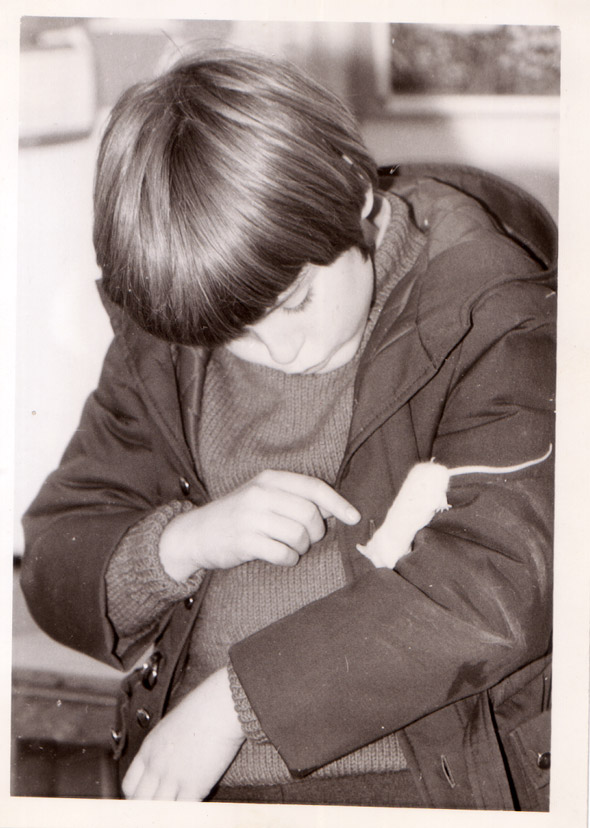
The sound of piglets squealing still sends a shiver down my spine. I’m back there now. I feel my hand being held tightly by my dad’s hand as he takes me there to see the pig sale.

“Gees, gees, gees!” he’d shoo some piglets out of our way. The smell’s overpowering. The auctioneer is pacing along planks placed between the pens, selling animals to the highest bidders.

The next time you buy a pack of shrink-wrapped pork at Tesco’s Abergele, remember that on this site, pigs once did squeal.
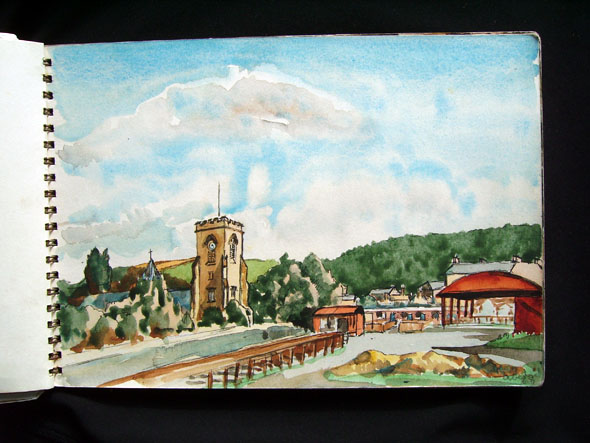
Abergele Livestock Market. Painted in 1969 by Harry Gee.

Abergele’s Old Windmill

We’ve already lost Abergele Market, Rhyl Watertowers and Colwyn Bay’s Astra Cinema.

If you walk up Chapel St to Mynydd Seion and turn left at the flat-roofed building that sells tiles (previously a printers and a laundrette before that), you’ll  come to a red-bricked warehouse. This warehouse used to be taller and it used to be attached to an old whitewashed stone windmill.

I don’t know how that old windmill at the junction of Chapel St with High St came to be demolished, but it’s a shame it’s gone because we’ve lost one of Abergele’s important landmarks.

My grandfather Harry Gee was a watercolourist and loved painting that old windmill while it still stood. As they say: “when it’s gone, it’s gone”, and now all I’ve got to remind me of this old piece of Abergele is my grandfather’s painting of it.

The Old Windmill, Abergele. Painting by Harry Gee.

Lewis’s Sale

Twice a year there’d be an ad and a pricelist in the Abergele Visitor announcing Lewis’s Sale, Lewis’s was the men’s clothes shop next door to the Gwindy.

The owner had a name that really suited her personality: Jolly Much – a lively and kind woman.

Jolly would have a start date, tempting pricelists available for days beforehand, balloons and limited launch offers to build anticipation. She’d also stick paper on the windows to cover up the bargains until the ‘reveal’ on the first morning of the sale.

Skinny ribbed polo necks were in fashion and mum bought me a mustard one that was a bargain. I wanted to look like Illya Kuryakin from The Man from U.N.C.L.E.

In the 1970s, underpants were generally sold individually, but Jolly would bundle up the pants and socks so you’d get five pairs for 50 new pence.

Yes, the Abergele shop owner who really knew how to stage a sale was Lewis Bros’ Jolly Much.

Lewis Bros ghost sign
This ghost sign next door to the Gwindy Abergele is all that remains to remind us of Lewis Bros

Magic Potions

When they were younger, our children loved making magic potions. They’d fill jam jars with water, mud, my wife’s perfume, Fairy Liquid, etc. Then they’d seal the lid and put them on display on their bookshelves for weeks.

Is there a genetic urge that makes us want to do this, I wonder? I ask because, when I was a child growing up in Abergele, I used to love making magic potions too.

Ann Morris and I would pick rose petals from the front gardens along High St and crush them between two rocks and mix them with water in a jam jar to make ‘perfume’.

In late summer, we crushed blackberries, elderberries and bilberries to make ink. And we even used the juice of raw onions to make invisible ink. It brought tears to our eyes. To reveal the writing we had to hold the paper close enough to a candle flame to heat the paper without burning it.

We’d make stinkbombs by throwing lighted matches into an empty Haliborange bottle, then close the lid quickly and wait until the flame went out.

Unscrew. Sniff, sniff. Phew!

Killer Jar

We were fascinated by killing bugs when we were children and we devised some pretty cruel ways of doing the killing.

The smallest bugs we’d kill were those tiny red spiders – about the size of a full-stop – that dash along the tops of walls when it’s sunny. We’d fry those by focusing a tiny dot of on their backs with a magnifying glass.

The other bugs we killed we called ‘smack bottoms’. They were actually wood lice but Michael Hughes and I lifted logs, grabbed a handful of woodlice and gave them a … smack bottom.

The weirdest and most elaborate contraption we used to kill bugs was called a killer jar. We’d tear up laurel leaves picked from Bryn Aber and pop the pieces into a jam jar. We’d throw in a daddy longlegs, screw the lid tightly and watch the poor spider die slowly from the laurel fumes.

I’m ashamed now of the killing and I don’t know why I did it. Is it human nature to take pleasure in this?

Mildred in 1971
Mildred in 1971

Eels

One summer my brother and I were walking up the river Gele when we spied some older boys with guns. They each had a powerful air pistol. As they walked up the stream in the water they’d stop periodically, lift a rock and fire a shot into the water. At their belts they’d tied a bouquet of twitching dead eels.

Hoping they wouldn’t shoot us, we plucked up enough courage to go a talk to them. They said they were selling the eels to a local fishmonger and shooting them through the head was the fastest way to catch eels.

My dad had a scar on his finger from a bite an eel gave him when he was tickling for trout, with his arm up to his armpits under a rooty riverbank.

We hated it when eels fouled up our night lines. We set them to catch trout. Hoping to pull up a fat trout in the morning we’d detest it when a slimy writhing eel was wrapping itself in yards of monofilament.

Once we decided to cook one to see what it tasted like, once and for all. Gutting an eel is no fun. Having done that though, we cut it into one-inch sections to get it into the aluminium  billy can on the Camping Gaz  burner.

“Oh my God, it’s still alive!” I shouted to my brother. The sections of frying eel were twitching and curling in the pan.

The smell was hyper-fishy and as we nervously bit into the yellowish flesh, I can still remember that bony, rubbery fishy foulness that exploded in my mouth.  And I swear the beast gave one last wiggle as it slid down my throat.

1972 cook-out at Paul Watkins's

Eyewitness account of Abergele rail accident

“The Fenians were supposed to have the secret of a mysterious combustible known as “Greek Fire” which was unquenchable by water. I think that “Greek Fire” was nothing more or less than ordinary petroleum, which was practically unknown in Europe in 1866, though from personal experience I can say that it was well known in 1868, in which year my mother, three sisters, two brothers and myself narrowly escaped being burnt to death, when the Irish mail, in which we were travelling, collided with a goods train loaded with petroleum at Abergele, North Wales, an accident which resulted in thirty-four deaths.

“Terrible as were the results of the Abergele accident, they might have been more disastrous still, for both lines were torn up, and the up Irish mail from Holyhead, which would be travelling at a great pace down the steep bank from Llandulas, was due at any moment. The front guard of our train had been killed by the collision, and the rear guard was seriously hurt, so there was no one to give orders. It occurred at once to my eldest brother, the late Duke, that as the train was standing on a sharp incline, the uninjured carriages would, if uncoupled, roll down the hill of their own accord. He and some other passengers accordingly managed to undo the couplings, and the uninjured coaches, detached from the burning ones, glided down the incline into safety. From the half-stunned guard my brother learned that the nearest signal-box was at Llandulas, a mile away. He ran there at the top of his speed, and arrived in time to get the up Irish mail and all other traffic stopped. On his return my brother had a prolonged fainting fit, as the strain on his heart had been very great. It took the doctors over an hour to bring him round, and we all thought that he had died.

“I was eleven years old at the time, and the shock of the collision, the sight of the burning coaches, the screams of the women, the wreckage, and my brother’s narrow escape from death, affected me for some little while afterwards.”

– Lord Frederick Hamilton, The Days Before Yesterday.