Eels

One summer my brother and I were walking up the river Gele when we spied some older boys with guns. They each had a powerful air pistol. As they walked up the stream in the water they’d stop periodically, lift a rock and fire a shot into the water. At their belts they’d tied a bouquet of twitching dead eels.

Hoping they wouldn’t shoot us, we plucked up enough courage to go a talk to them. They said they were selling the eels to a local fishmonger and shooting them through the head was the fastest way to catch eels.

My dad had a scar on his finger from a bite an eel gave him when he was tickling for trout, with his arm up to his armpits under a rooty riverbank.

We hated it when eels fouled up our night lines. We set them to catch trout. Hoping to pull up a fat trout in the morning we’d detest it when a slimy writhing eel was wrapping itself in yards of monofilament.

Once we decided to cook one to see what it tasted like, once and for all. Gutting an eel is no fun. Having done that though, we cut it into one-inch sections to get it into the aluminium  billy can on the Camping Gaz  burner.

“Oh my God, it’s still alive!” I shouted to my brother. The sections of frying eel were twitching and curling in the pan.

The smell was hyper-fishy and as we nervously bit into the yellowish flesh, I can still remember that bony, rubbery fishy foulness that exploded in my mouth.  And I swear the beast gave one last wiggle as it slid down my throat.

1972 cook-out at Paul Watkins's

Eyewitness account of Abergele rail accident

“The Fenians were supposed to have the secret of a mysterious combustible known as “Greek Fire” which was unquenchable by water. I think that “Greek Fire” was nothing more or less than ordinary petroleum, which was practically unknown in Europe in 1866, though from personal experience I can say that it was well known in 1868, in which year my mother, three sisters, two brothers and myself narrowly escaped being burnt to death, when the Irish mail, in which we were travelling, collided with a goods train loaded with petroleum at Abergele, North Wales, an accident which resulted in thirty-four deaths.

“Terrible as were the results of the Abergele accident, they might have been more disastrous still, for both lines were torn up, and the up Irish mail from Holyhead, which would be travelling at a great pace down the steep bank from Llandulas, was due at any moment. The front guard of our train had been killed by the collision, and the rear guard was seriously hurt, so there was no one to give orders. It occurred at once to my eldest brother, the late Duke, that as the train was standing on a sharp incline, the uninjured carriages would, if uncoupled, roll down the hill of their own accord. He and some other passengers accordingly managed to undo the couplings, and the uninjured coaches, detached from the burning ones, glided down the incline into safety. From the half-stunned guard my brother learned that the nearest signal-box was at Llandulas, a mile away. He ran there at the top of his speed, and arrived in time to get the up Irish mail and all other traffic stopped. On his return my brother had a prolonged fainting fit, as the strain on his heart had been very great. It took the doctors over an hour to bring him round, and we all thought that he had died.

“I was eleven years old at the time, and the shock of the collision, the sight of the burning coaches, the screams of the women, the wreckage, and my brother’s narrow escape from death, affected me for some little while afterwards.”

– Lord Frederick Hamilton, The Days Before Yesterday.

Danny and the George

Everyone remembers their first pint. Mine was a pint of sweet nutty Ansell’s Mild at the Pen y Bont pool bar and it cost me 28p. I won’t mention how old I was at the time.

Abergele being a market town had loads of pubs and each one had its own personality.

The Gwindy was a bikers’ pub.

The Harp was a farmer’s pub and drew an older crowd back in the 1970s.

The Bee had fab Welsh hymn singing every Saturday night.

After the Mormons left, The Bull became popular with Rotary and Round Table.

I didn’t drink in the Castle, but I always reckoned it was popular with Maes Canol dads.

The Hesketh, like many others, was two pubs in one – very young in the bar and much older in the lounge.

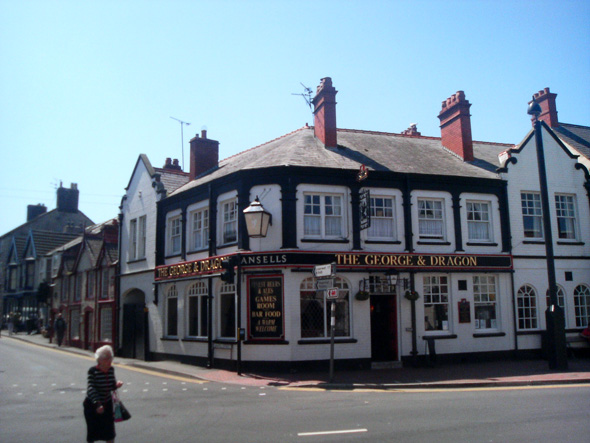
The landlords and landladies of Abergele pubs are what defined the pub and one pub that kept me coming back, time after time, is the George and Dragon, thanks to its landlords Danny and Mary.

For many years now, Danny’s been larger than life, with-a-hint-of-a-Scouse-accent, rugby supporting, fundraising Danny.

Apart from Royston :-), the George’s clientele has changed over the years: from the farmers of the 70s, the young crowd in the 80s and older drinkers in the 90s. There’s been one constant through the decades – Danny – one of Abergele’s shining stars.

George and Dragon pub Abergele

New series of Abergele in Shorts

I wrote these two-dozen Abergele in Shorts stories back in 1996, while I was living in the Republic of Ireland.

In a week’s time, I’m publishing the first of another ten or so brand new Abergele in Shorts on this website, every week or so leading up until the end of 2011.

Please bookmark this site, feel free to share the news on Facebook or Twitter and come back here at 2pm on Friday 7 October.

I’ve also just set up a brand new free weekly email newsletter which you can sign up for to get these new stories in your inbox every week (usually Monday). You can sign up by typing your email address in the form at the top right of this page, just under the search box.

I’m really excited about the new series of Abergele in Shorts and I hope you enjoy reading them.

Adopted by Abergele

I recently came across an interesting article about Abergele during World War II. During WARSHIP WEEK, a National Saving Campaign in 1942, Abergele community raised money to adopt two ships. One was a Flower Class Corvette named HMS HOLLYHOCK  (launched August 1940) and the other a River Class Frigate named HMS DERG (launched January 1943).

HMS HOLLYHOCK served in the Far East but was unfortunately sunk in April 1942, off Ceylon (Sri Lanka), in an attack by aircraft from the Japanese aircraft carrier SORYU, with the loss of 53 lives.

HMS DERG served through till the end of the war on convoy duties to South Africa. She was renamed to HMS WESSEX in 1951 (later HMS CAMBRIA) and was used as a training ship until she was broken up in 1960.


The town was presented with a plaque by the Admiralty .

The inscription reads;

PRESENTED BY

THE LORDS COMMISSIONERS OF THE ADMIRALTY

TO ABERGELE URBAN DISTRICT COUNCIL

TO COMMEMORATE THE ADOPTION OF

H.M.S. HOLLYHOCK and H.M.S. DERG

DURING WARSHIP WEEK.  MARCH 1942

Bee Field Memories

I was reminded about life in the old “Nashy” Junior School in Abergele while reading through The War Years by Robert J Griffith. In his book, he talks about the Army Cadet Force during the Second World War. “their headquarters was in two Nissan huts opposite the National School where the Americans had once been based and had used as a canteen”. This recollection reminded me of my early days in the school when the Nissan huts still existed and we used it as a canteen also. We used to have to walk across the road, under the escort of the teachers, to await the arrival of school dinners. They always arrived in a little van and the food was in large metal containers. I can still smell it today. I have no idea from where the food came but I remember it well. Of interest, I didn’t know that Americans were based in Abergele during the War.

This brings me to ask, when did the Nissan huts get removed ? I think it must have been done by Slaters to extend their parking area and well before the Tesco development. There was also a bus station where you could find Harold and Bert sheltering from inclement weather. I have looked but never been able to find any photographs of the Bee field in those days. I can remember what it was like in the Sixties, the Nissan huts, bus station and toilet block (which I believe did disappear during the development for Tesco) and of course the Sale Yard and Scout hut, located at the bottom, roughly where the fire station is now.

If anyone has photographs or memories they would like to share please comment to this post.

What used to go on at Cae Stalwyn, Abergele.

Here’s a short digital story I’ve just made about the old Abergele Show. It was Brian Haynes – my dad’s neighbour – who told me about the ‘swimming’ of horses from boats from Ireland anchored off Pensarn beach.

(If the embedded video won’t play, here’s a link to it on blip.tv)