
Following on from my post last week, here are some more gems from Colin Knowlson’s collection:
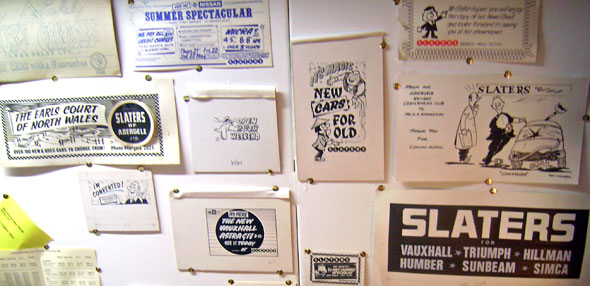
Following on from my post last week, here are some more gems from Colin Knowlson’s collection:
The Earl’s Court of Abergele and more. These may bring back memories. From Colin Knowlson’s collection.

…this weekend for your family’s traditional Easter Picnic, have a good one. Best wishes at Easter to all our AbergelePost readers:

A woman on holiday in a caravan park in Towyn went into Ellesmere’s hardware shop, Abergele, and asked:
“Excuse me, I’d like to buy a tundish”
“A what?” asked shop assistant G., whose first language was Welsh.
“A TUNDISH”
G. excued himself a moment and went to ask Mr Ellesmere in Welsh what a tundish was.
“It’s a bloody twmffat G.!”
“Aaah” sighed G., turning to the woman he said:
“Now why didn’t you say you wanted a bloody twmffat!?”


When I opened the door, imagine my surprise to be staring at a big shiny red fire engine, with the words Abergele Urban District Council writtern in gold letters running along its side.
Slaters of Abergele is a name well-known throughout the country and now Colin Knowlson has archived his family’s motor company’s historical artefacts, images and documents. And he’s been giving historical and motivational talks to local societies and to people of all ages throughout north Wales.

Colin has some real gems in his photographic archive:
– a photo of world famous boxer and Gwrych Castle resident Randolph Turpin posing outside Slaters Garage
– an ariel photo of Abergele that must surely have been taken from a hot air baloon, because there were no cars on any of the roads and just one solitary horse and cart on Market Street.
– photos of the interior of the Teddy Jones-run Slater and Wheeler machine shop which turned out military equipment during WWII
– and many more fantastic photos
I’m sure to return here in the future to stories of Slaters and of old Abergele told to me by Colin today. But for now, I’ve just got a big smile on my face having seen that big shiny red old Abergele fire engine.

“Make sure you’ve put on clean socks Gareth, I’m taking you to have your feet measured after school today,” said Mum.
Last time, it was a shiny tape measure bound around my socked foot; this time it was a device with moving walls which closed in around my feet. It was scary and reminded me of that room with spiked walls in Batman with Adam West. What if the walls kept squeezing in?
However high-tech foot measuring became, it was never something I looked forward to – like having a haircut or a filling.
The only thing that kept me going was the possibility of getting a pair of Tuf shoes with a magnetic compass hidden in the sole.
As we grew older, we were tempted by Clark’s Polyveldts and Nature Treks. I had two pairs of Nature Treks. They smelled gorgeous but the soles split all the way through on both of them.
After reaching Size 5, I waved goodbye to The Shoe Box and started going to Colwyn Bay Indoor Market to buy my own choice of shoes – Monkey Boots. A perfect match for those drainpipe denims, ex-army top and a trip on the train to Eric’s Liverpool to see Stiff Little Fingers in 1978.

The Abergele Visitor was pushed through our letterbox every Friday. It was printed in Abergele, in a room with lino on the floor above the Visitor Office newsagents, next door to the Bee.
Our neighbour Gordon Hughes was the printer and the noise of the rolling presses made it difficult to hear him speak as he explained how he set the lead type mirror-imaged for each week’s edition.
The paper’s chief photographer was Mr Sumners who had his office and darkroom between the Visitor Office and Woolworth’s. Mr Sumners seemed to be at every wedding, summer fete, sports day and chapel parade. He’d develop his own photos and put prints of his latest shoots in his shop window, giving passing shoppers a good idea of what had been going on in Abergele that week.
Nowadays many local and regional papers are owned by bigger and bigger companies, based further and further away from their readers. But there’s something really cosy about remembering the days when the stories of Abergele were told by the people of the town itself. People like Gordon Hughes and Mr Sumners.

Abergele is know as a market town because there used to be a livestock market here every Monday in the 1960s and 70s.
The town filled up with land rovers, tractors and trailers and farmers wearing flat tweed caps and holding shepherd’s crocks.
The market tradition is one that stretched back in time and there are old postcards that show that livestock trading used to take place on the main Market Street itself.
As you look today at Abergele Tesco, it’s hard to imagine that site was once full of corrugated iron sheds and animal pens, with the sounds and smells of prime Welsh livestock.
The sound of piglets squealing still sends a shiver down my spine. I’m back there now. I feel my hand being held tightly by my dad’s hand as he takes me there to see the pig sale.
“Gees, gees, gees!” he’d shoo some piglets out of our way. The smell’s overpowering. The auctioneer is pacing along planks placed between the pens, selling animals to the highest bidders.
The next time you buy a pack of shrink-wrapped pork at Tesco’s Abergele, remember that on this site, pigs once did squeal.
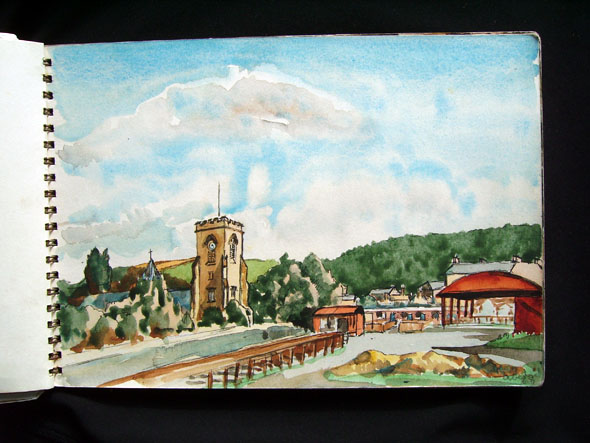
We’ve already lost Abergele Market, Rhyl Watertowers and Colwyn Bay’s Astra Cinema.
If you walk up Chapel St to Mynydd Seion and turn left at the flat-roofed building that sells tiles (previously a printers and a laundrette before that), you’ll come to a red-bricked warehouse. This warehouse used to be taller and it used to be attached to an old whitewashed stone windmill.
I don’t know how that old windmill at the junction of Chapel St with High St came to be demolished, but it’s a shame it’s gone because we’ve lost one of Abergele’s important landmarks.
My grandfather Harry Gee was a watercolourist and loved painting that old windmill while it still stood. As they say: “when it’s gone, it’s gone”, and now all I’ve got to remind me of this old piece of Abergele is my grandfather’s painting of it.
